Infrared Roof Moisture Survey
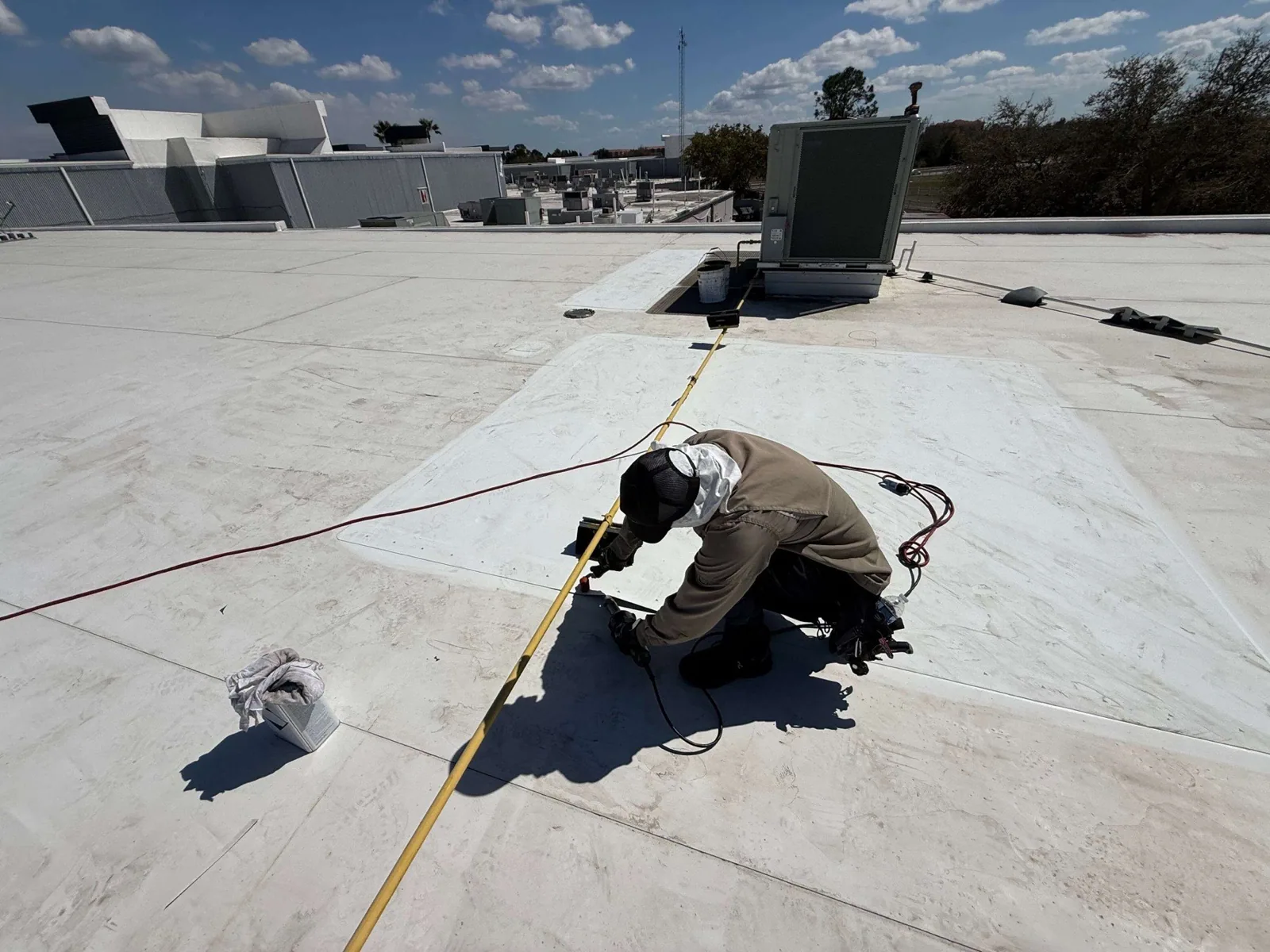
After a spring storm, a roof can look dry while water remains inside the assembly. First, we document active interior reports and establish a safe roof route, then decide whether conditions support infrared screening and confirmatory openings. The Tulsa area receives its most frequent rain in spring, when showers and thunderstorms recur; late-summer heat also affects roof-surface conditions and the timing of a survey. Infrared imaging can identify temperature patterns that may correspond to moisture, but it does not directly measure water or prove that insulation is wet. We interpret the scan with roof construction, recent weather, surface conditions, and targeted core cuts where the findings warrant verification. A hands-on roof inspection remains part of the process because seams, drains, flashing, and prior repairs provide context the camera cannot supply. The result is a mapped set of observations with clear limits and a practical next step.
Choose survey conditions carefully
Infrared contrast depends on the roof assembly, surface, weather, and timing. We review the roof type, insulation, membrane color, recent rain, cloud cover, wind, and rooftop equipment before selecting a survey window. The surface must gain and release heat in a way that produces useful differences; some assemblies or weather patterns do not provide a reliable scan. Wet areas can cool at a different rate from dry portions, but ballast, shading, equipment, ponding, and material transitions can also create temperature variations. We record the conditions and explain how they affect interpretation. Tulsa-area late-July through early-September temperatures frequently reach 100°F or higher, so heat exposure and safe access shape the field plan as well as scan timing. The roof is divided into marked sections, and access points are recorded so scan results can be compared with direct observations and later repair work.
Treat patterns as leads, not conclusions
A thermal pattern is a lead for verification, not a moisture diagnosis by itself. We compare thermal images with visible roof conditions, interior reports, drainage paths, and known equipment locations. A suspicious area is mapped and checked from the surface; where appropriate, a core cut confirms the layers and moisture condition at that point. Testing points are chosen to answer a specific question and then restored to maintain the roof. We label confirmed findings separately from areas that only merit another look. Creek 51 Business Park is a light-industrial park at the Creek Turnpike and Highway 51 junction. Before a scan or test opening there, we confirm roof entry with the selected building's contact. We can pair an aerial roof survey with thermal screening and targeted openings to map accessible areas and verify suspected moisture. The report states which methods were used, where they were applied, and what remains outside the tested locations.
Give each finding a roof location
A useful survey gives the building team a map, not a collection of disconnected images. We label roof sections, reference drains, curbs, seams, and access points, and tie every thermal image and core location to that plan. Each finding includes the observed pattern, the confirmation status, and any interior report that corresponds to it. We avoid drawing a boundary beyond tested evidence; an isolated core cut does not establish the condition of every nearby square foot. If multiple suspect areas appear, the owner can prioritize openings based on active water, assembly details, and project timing. Around The Shops at Aspen Creek, retail and mixed-use properties may need inspection windows that avoid high activity; the contact confirms tenant access and any staging limits. A photo condition report can combine thermal views, surface photographs, core results, and recommended actions in one record for ownership and facility staff.
Connect confirmed moisture to the roof decision
Once moisture has been confirmed, the next question is how much material is affected and how the roof can be restored. A small, bounded area may support localized removal and repair if surrounding insulation, deck, and membrane are sound. Broader saturation or repeated wet areas may change the scope toward recover eligibility or replacement. We compare findings with drainage, attachment, layer count, and the condition of adjacent details before recommending a path. A recover assessment considers whether the existing assembly can remain, while a replacement evaluation plans removal where evidence calls for it. The report identifies any untested zones and the reason for additional sampling instead of implying that infrared alone settles the decision. On a single-ply roof such as TPO membrane, construction details affect which locations can be opened and restored. Northeastern State University's Broken Arrow campus at New Orleans Street includes multiple buildings and offices, so each scan and moisture finding is mapped to its building and roof section.
Preserve the survey for follow-up
At closeout, we review the map, scan conditions, confirmation points, repaired core locations, and recommended follow-up with the building contact. The record helps a later inspection revisit the same areas and compare them after repairs or additional weather exposure. We note access limits and any parts of the roof that could not be scanned or tested. If the owner authorizes repair, the map can define work areas and guide a targeted repair scope; after work, the affected zones can be checked against the original record. A planned maintenance inspection can revisit drains and previously wet locations before another storm season. Tulsa-area hail reports peak in spring and can be localized. The survey map ties any confirmed moisture to the inspected roof sections. We retain the scan timing and field conditions with the map so a later reader can interpret each thermal pattern in context. The handoff leaves ownership with a verified-versus-suspected distinction and a next action for each mapped area.
An infrared scan is useful only when surface conditions support a meaningful comparison. We confirm recent weather, roof temperature, solar exposure, and the assembly before interpreting thermal patterns. Wet insulation is not diagnosed from color alone; suspected areas may need test cuts or another confirmation method. We mark scan boundaries, rooftop equipment shadows, ponding, and inaccessible zones so the owner knows where results are limited. If a scan identifies a possible anomaly, we compare it with interior reports and inspect the area directly where safe. A test opening is proposed only when it answers a scope question, such as whether insulation should be removed or a repair boundary should expand. The report records calibration details, scan time, images, and confirmation locations. That creates a repeatable baseline for a later survey and prevents an unverified image pattern from being presented as a final roof condition.
Commercial Roofing Questions
Does an infrared scan prove that insulation is wet?
No. It identifies temperature patterns that may correspond to moisture, along with other conditions. We compare those patterns with the roof assembly and use targeted core cuts where direct confirmation is needed.
What conditions can interfere with the survey?
Recent rain, wind, cloud cover, shading, rooftop equipment, ponding, surface materials, and the time of day can affect thermal contrast. We record the conditions and may reschedule if the scan would not produce useful information.
Will you core-cut every area that looks unusual?
No. We select openings to answer specific questions and confirm patterns that could change the roof decision. Each opening is mapped, documented, and restored; untested areas remain identified as unconfirmed.
How can moisture mapping inform a repair-versus-replacement scope?
The survey contributes evidence, but the decision also depends on the extent of confirmed moisture, deck and membrane condition, attachment, drainage, and existing roof layers. We show how those findings support the available options.
Can infrared inspect a roof after a hail event?
It may help identify areas for closer investigation when conditions suit the method, but it does not establish hail damage by itself. We document visible roof conditions separately and verify suspected moisture through appropriate testing.